
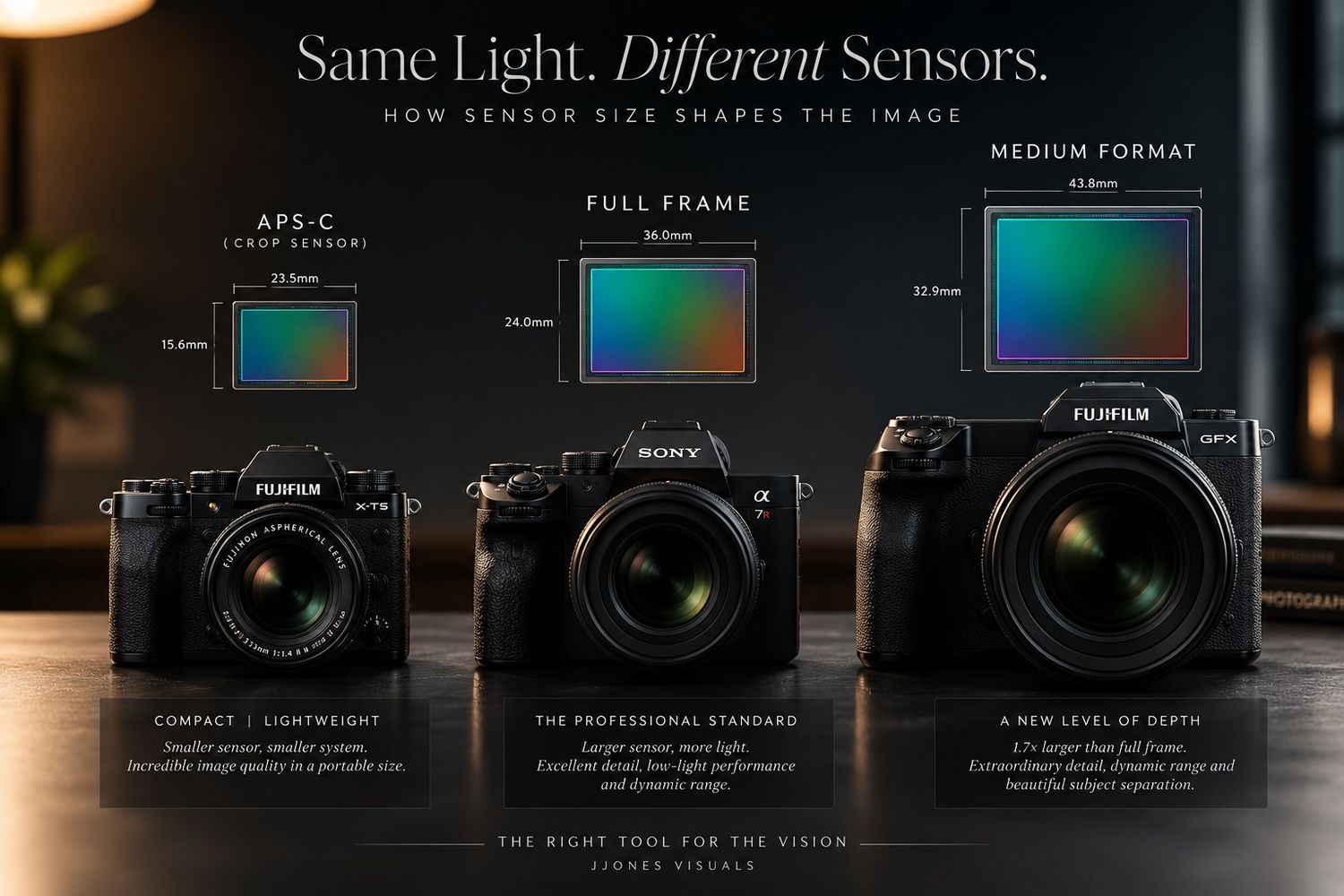
If you've spent any time researching cameras, you've probably heard terms like crop sensor, full frame, and medium format. While they may sound like technical jargon, they all refer to one thing: sensor size—and it plays a major role in how a camera captures light and ultimately creates an image.
To keep it simple, when you press the shutter, light travels through the lens and strikes the camera's sensor. The sensor records that light and color information, allowing the camera to create the photograph you see.
There are three primary sensor sizes you'll hear photographers talk about.
APS-C (Crop Sensor)
APS-C cameras have a smaller sensor than full-frame cameras. Because of this, the cameras and lenses are generally smaller, lighter, and easier to carry. They also create a narrower field of view, which is why they're often referred to as "crop sensor" cameras.
Despite their smaller size, today's APS-C cameras are incredibly capable and can produce stunning professional images.
Full Frame
Full-frame cameras use a larger sensor that captures more light and a wider field of view. For years, full frame has been considered the professional standard because of its excellent image quality, low-light performance, and dynamic range.
Historically, a larger sensor almost always meant noticeably better image quality. Today, advancements in camera technology have narrowed that gap considerably. In the hands of a skilled photographer, incredible images can be created with any modern camera system.
My Journey with Fujifilm
I began my photography journey shooting Fujifilm APS-C cameras, and they quickly became more than just a tool—they became part of how I saw the world.
I fell in love with their compact size, beautiful ergonomics, legendary color science, film simulations, and perhaps most importantly, the way they render skin tones. Many photographers can recognize a Fujifilm image straight out of the camera because it has a distinct character that's difficult to describe but easy to appreciate.
At one point, I switched to Sony to see what all the excitement was about. While Sony makes exceptional cameras, I found myself missing something. The files were technically excellent, but they didn't inspire me in the same way.
So I came back to Fujifilm.
For me, the connection you have with your camera matters just as much as the specifications. When a camera inspires you to create, you naturally become a better photographer.
Discovering Medium Format
Eventually, my curiosity led me to another sensor format: medium format.
Medium-format sensors are approximately 1.7 times larger than full-frame sensors, allowing them to gather even more light and capture an incredible amount of detail.
When I picked up the Fujifilm GFX100S II, everything changed.
Within a single portrait session, I knew this was the system I wanted to build my work around.
Why I Fell in Love with Medium Format?
Incredible Detail
With a 102-megapixel sensor, the GFX produces enormous image files packed with information. That extra data gives me tremendous flexibility during editing while maintaining exceptional image quality.
Flexible Cropping
The high resolution allows me to crop aggressively when needed without sacrificing detail. Whether I want a tighter portrait or a different composition, the files hold up beautifully.
Exceptional Dynamic Range
Dynamic range refers to how well a camera captures detail in both the brightest highlights and the darkest shadows.
Medium format gives me incredible flexibility to recover details while preserving smooth tonal transitions, resulting in images that feel rich, natural, and dimensional.
Beautiful Subject Separation
One of my favorite characteristics is the way medium format renders depth.
The larger sensor creates a unique, natural-looking separation between the subject and background. It's not simply more background blur—it's a smoother, more three-dimensional transition that gives portraits an unmistakable sense of depth.
A Slower, More Intentional Workflow
This might surprise people, but one of my favorite things about the GFX isn't technical at all.
It's the pace.
The camera encourages me to slow down, refine my composition, perfect the lighting, connect with my subject, and create intentionally rather than relying on rapid-fire bursts of hundreds of images.
That philosophy aligns perfectly with how I approach every session at J Jones Visuals.
Does Medium Format Matter?
Truthfully, most clients won't immediately recognize whether an image was captured on APS-C, full frame, or medium format.
What they will notice is how the photograph makes them feel.
For me, medium format isn't about owning a bigger camera or chasing specifications. It's about having a tool that helps me create portraits with greater depth, richer tonality, and a refined editorial quality that reflects my artistic vision.
At J Jones Visuals, every portrait is created with intention. Medium format is simply one of the tools that helps transform that vision into an image you'll be proud to display for years to come.
About J Jones Visuals
J Jones Visuals creates cinematic, story-driven portraits, headshots, lifestyle imagery, and event photography throughout the Atlanta area. Every session is designed to highlight personality, emotion, and authentic moments through intentional lighting and thoughtful composition.